 in a
field trip account, click it to get a page of collecting site photos!
in a
field trip account, click it to get a page of collecting site photos!Spider Collector's Journal (36th page: 2026) Copyright © 2026 by Rod Crawford
Here's the 36th page of narratives of fun (and not so fun) trips to collect spiders for research at the Burke Museum, some accompanied by capable field volunteers: Laurel Ramseyer and new recruits. Most also appeared in Scarabogram, newsletter of "Scarabs: The Bug Society." Dates of field trips head each paragraph. Maps showing the location of sites within Washington state follow the grid system outlined in the Washington Spider Checklist. RETURN TO INDEX
Where you see this button in a
field trip account, click it to get a page of collecting site photos!
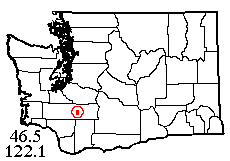 |
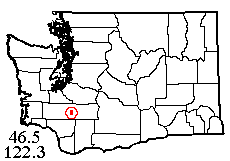
4 IV 2026: Kathy had been abroad all winter (Laurel too, but Kathy returned first). We got together as soon as weather allowed, with Jerry Austin and a student from Bellingham, Carter Kitterman. I let the warmest forecast decide our goal, the vicinity of Glenoma in central Lewis County. First stop was on Anderson Road where it passes through private forest lands in the foothills above the Cowlitz Valley. Street View had shown me a gated road into riparian woods, with no keep-out signs. Alas, in the one year since the photos were taken, they posted signs! But we were still able to sample habitats in and near the county road right-of-way. Carter and I started by beating a very nice 14 species from young Douglas-firs. We got little that was mature in the ground-active fauna… until Carter spotted a big adult wolf spider Tarentula kochii crossing the paved road! Kathy and I beat some ferns for 8 species; and Jerry sifted moss on alders for 16, richest sample of the day though Pimoa-dominated. Having done what we could without (much) trespassing, onward to site 2.
Back the way we came and westward toward Riffe reservoir, we were in Tacoma municipal land (they own the Cowlitz hydro-power system), all public. At our second main stop were groves of various deciduous tree species and big grassy fields (harvested for hay, I suspect), all in flat land near the water table, ready for litter sifting and grass sweeping. Spiders in the litter were a bit sparse, but by persisting through several groves, Carter and I came up with 10 spider species and a few harvestmen; every grove had its Ozyptila pacifica crab spider, one of Laurel's favorites. Kathy and Jerry got 9 species sweeping grass, and there were a few more on local conifers. And Carter found here several active mature Pardosa vancouveri.
To top off the sample we stopped at Glenoma Community Park, where I and Jerry got Salticus scenicus on a sports building and Carter found an adult Pholcus in the men's room. With 48 species from Glenoma, we got our burgers at Spiffy's in Morton.
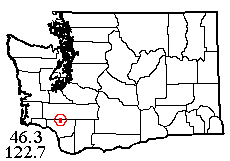 |
29 IV 2026: Thanks to assorted delays (bad weather, Kathy got sick, then I got sick), our second trip was delayed until after Laurel's most-welcome return from Europe. As luck fell out, it was only she and I who headed south on our first collecting around large Silver Lake in the Toutle Valley, northern Cowlitz County. First stop was Silver Lake Cemetery, an average-looking sort of cemetery with its proper quota of recessed grave vases, giving Laurel a nice set of 6 species featuring the "grave vase Palliduphantes". I got 8 from conifer foliage, Laurel added 3 from a service shed, one from Douglas-fir cones and one strolling along a fence wire. Three from salal and a Pardosa running through the grass brought us up to 24 species already, reasonably interesting including western Washington's first Erigone autumnalis from the vases.
Half a mile further up the highway, Hall Road brought us to a good-sized tract of riparian woodland (the far edge was the shore of large Silver Lake); I later learned it was part of the Hall Road Wildlife Area. In the woods were bits of wetland, and many of the trees were cedar that don't mind having their feet wet. Here, sifting, understory and sedge painlessly brought us up to 42 species.
For the last main habitat, I had in mind a tract of school-district-owned grassland within a short walk of where we were parked for the woods. But for whatever reason, the Toutle School District had surrounded that land with an electric fence! However, Laurel spotted an unfenced grassy tract across the highway, part (I later learned) of the wildlife area. This happy discovery topped off our collection with some great wetland species, though we got through the meadow dry-shod; the sample included Tetragnatha caudata and an apparent new species of the erigonine genus Satilatlas. The day's total was 53, amazing for only 2 collectors!
We made a brief stop at a lakeshore boat launch but only to use the outhouse. A most satisfying post-field meal at Betty's Place in Toledo sent us homeward happy.
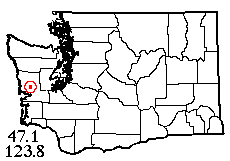 |
7 V 2026: Seeking moderate temperatures (and an un-sampled cemetery), Kathy, Laurel and I went west to the upper reaches of the East Fork Hoquiam River, to collect along an unnamed tributary on property of Fruit Growers Timberlands, whom we thank for access. Parking at a friendly gate, we walked through riparian (though mostly conifer) forest to a bend in the road that took us into uplands, where the road's wide shoulders were covered with new-looking grass that Kathy at once began to sweep. Here the not-so-old forest was Douglas-fir, but all the younger roadside trees were western hemlock and Sitka spruce; there were enough of these for a plentiful conifer foliage sample of 10 species, with one microspider I don't recognize. Then I beat roadside salal, adding colorful Theridion californicum. Kathy and I beat roadside ferns for one more species. Kathy had swept so many spiders from the grass, she figured she had 20 species in her sample; I bet she had no more than half that many. She won the bet! A 19-species sweep sample in such a place is phenomenal, and 2 more from Laurel's Douglas-fir cone sample brought us up to 24 total.
Now the sun burned through the clouds and we retreated to the riparian zone, where Laurel and I gathered moss and leaf litter, respectively, to sift. The litter added 3 species; the moss, 11, including an unusual Dipoena. Laurel swept along the creek, adding nothing new, and got several spiders out of someone's discarded boat-propeller cone, adding another species. The forest here was very attractive, with highly diverse understory. Back at the paved road, Laurel's search of the guardrail got 3 repeat species and added Theridion agrifoliae for a nice total here of 40 species.
Laurel still wanted to visit Humptulips Cemetery to the NW, in yet another unsampled gridspace. We found it readily, and I began conifer and grass sampling while Laurel searched the graves for those recessed vases that make such a good spider habitat. This time she was unlucky, and got nothing from the few vases not in use! She did add one wolf spider and a Salticus from a monument, so we now have a 9-species head start from Humptullips.
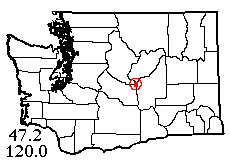 |
15 V 2026: On a day when 4 collectors were available, western Washington weather looked gloomy, so we headed east to Apricot Orchard Boat Launch (managed by the Public Utility District) at a bend in the dammed Columbia River. Arriving, we found the site perfectly OK, if not completely natural. Invasive cheatgrass was common but not altogether dominant; shrubs were mainly rabbitbrush (both gray and green) but sagebrush was also there. To my surprise, the extensive woody thicket was native willow and not Russian olive, so I started by sifting willow litter (pretty dry), giving me 2 dictynids and a female erigonine that looks wholly unfamiliar. Weather was mostly cloudy with sun breaks. Laurel and I got 4 species on and around the outhouse. Kathy and Jerry beat a huge amount of rabbitbrush, adding 13 more species. I only got one that was different from true sagebrush, and another of the little pale dictynid species from shaking tumbleweeds.
Laurel had found nothing new in plant-tip webs, but had good luck turning rocks in the riparian zone, with two more salticids and a good series of rare Steatoda washona; a large, speedy adult Scutigera centipede gave her an exciting time there!
With a little time left, I wanted to visit my pre-selected upland site on nearby Stuhlmiller Road. A jog in the road among wide acres of farmland went around an uncultivated gully on state property, with extensive fields of grass and flowering herbs (some of the species even native) available for sweeping. Down along the dry creek bed were shrubs and a huge pile of tumbleweeds. Sweeping added three good species, sagebrush two more, all things that had already run their race at the lower-elevation main site. Our final sample numbered 30-32 species.
 |
22 V 2026: With Laurel unavailable, Kathy, Jerry and I headed south to central Lewis County to take care of the area where the Tilton River meets its North Fork (we'd sampled up that fork in 2024). I planned to start out in a tract of working forest with lots of clearcuts along Road 73, in hopes of a prime conifer foliage sample, and we hit an especially good site, just before the road passes a riparian buffer along Jefferson Creek. To our left was a level tract cut in 2012, where a smaller rectangle along the road had been cleared of trees for some reason (maybe to harvest Christmas trees?) around 2022 and allowed to grow up in grass. The 2012 trees were big enough to cast a fair shadow. The rising ground right of the road had been cut in 2019 and the smaller Douglas-firs there were exposed to sun. This made for an interesting comparison! I beat the 2012 trees, getting 11 good spider species and a native harvestman; Jerry beat the 2019 trees for no less than 17 spider species, 9 different from my sample. Some interesting species there too. And Kathy swept the grass tract, for 13 species, adding 7 (lots of individuals too). Three habitats sampled for 24 species! A Cyclosa from bridge railings and an active Pardosa vancouveri made 26 from this first site. Especially interesting: the Oxyopes lynx spiders were youngest on the 2012 trees, older on the 2019 trees and some even mature on the grass, who knows why?
For a contrasting second site we picked a moist, deciduous-dominated forest tract on Dodge Road south of the main river. I began there by sifting alder-maple litter, for some nice harvestmen and isopods plus 7 additional spider species; best spider was the exceedingly rare male of the common, semi-parthenogenic six-eyed Usofila pacifica. Kathy added Metellina curtisi sweeping in an abandoned road. Jerry sifted a lot of tree moss and added 7 more. Kathy added 5 by beating ferns. Then Kathy and I swept grassy verge on the 2 sides of Dodge Road, from which I added 1 and she added another 5, including an unidentified Grammonota and a mature Dismodicus (a genus usually taken juvenile). We had such splendid luck on this trip from most habitats that we exceeded all expectations with 52 species!
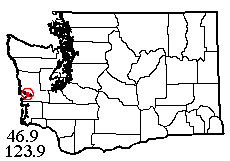 |
28 V 2026: This time it was only Laurel and I, heading for a cool coastal site to escape warmish weather. Our destination, planned a few years ago, was on the south shore of that big bay Grays Harbor, at the mouth of Stafford Creek, where there was a turnout to park off busy state Hwy. 105, one of the least pedestrian-friendly roads I've ever seen! Almost no shoulder, and cars honk at you even if you're ten feet from the road! An abandoned rail route passes through our site, called a trail on Google Earth, but the "trail" is wall to wall head-high blackberries! In effect, there is no practical way to hike along the south side of the bay, but we can't complain about the spider habitats at our site. I began by following a footpath, crossing the so-called trail, that leads past meadows and a giant spruce tree to a muddy little cove. I beat around 2/3 of the lowest branches of the big spruce and got 17 species! Late in the day Laurel and I each picked another spruce for more beating and added several more, for 25 in all from part of the foliage of 3 trees! Included was an unidentified dictynid and a couple of Theridion agrifoliae, one of which was bright green!
During the day (with clouds gradually clearing), we also swept meadows (16 species including Laurel's rare Clubiona norvegica and an unidentified linyphiid); beat Scots broom (9 species); and sifted moss (9 species). I swept the understory of the big spruce and found an adult Zelotes under a board; Laurel beat salal, sorted beach wrack, and found quite a colony of the introduced Australian desid, Badumna longinqua, on the concave side of the highway guardrail (honk, honk)! All within quite a narrow strip of terrain between the highway and salt water, part of it blotted out by blackberry; total 44 species, including some good ones.
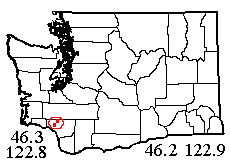 |
4 VI 2026: All 4 musketeers (Laurel, Kathy, Jerry and I) went south to Cowlitz County this time to hit two cemeteries in two different gridspaces: large Whittle-Hubbard Cemetery in Castle Rock, and smaller Rosin (a.k.a. Tower Road) Cemetery to the NE, plus a river site beyond. Laurel and Kathy duly took 18 of Laurel's Palliduhantes study subject in sunken vases at the big cemetery, but meantime Jerry was beating cedar trees and I slipped through a fence gap into someone's forest to get a fine understory sample. Adding miscellaneous other habitats, we actually totalled 24 species, a minimal full sample, from Whittle-Hubbard in about 2 hours. But half of those were introduced species!
At smaller Rosin Cemetery, Kathy took 4 species (including the study subject) from 18 vases. Laurel added 2 more from the chainlink fence, while I added a paltry 3 from usually productive Douglas-fir foliage. The most productive habitat was ferns, from which Jerry, I and Kathy got 19 species in all; Kathy and Laurel also took 11 from salal. It helped a lot when a curious neighbor gave me permission to stray onto her land. Three more from other habitats brought our total from this smaller cemetery to 31.
Our last stop was the Tower Bridge state water access site (not a state park, despite someone's homemade sign) on the Toutle River. This had upland tall grass by the parking area, riparian tall grass by the river, an extensive gravel bar, litter-dropping cottonwoods and alders (with moss too), and a bridge! Laurel also found some perched flood debris well up in some trees (the Toutle isn't always placid), and Jerry added a few from alder/willow foliage. My cottonwood litter sift got a couple that were unfamiliar. Though some riverside spiders duplicated species at the cemetery, we brought this gridspace up to 48 before moving on to Betty's Place (Toledo) for well-earned burgers and shakes.
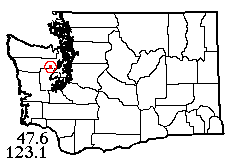 |
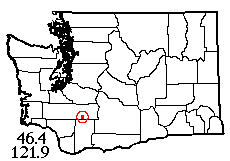
12 VI 2026: For this trip Laurel was gone and Jerry unavailable, so I sent out some invitations. Sage Osterman, just out of a Renton high school, for whom I'd identified online photos, agreed to join us. Little knowing what she was getting into, Kathy decided on the Lena Lake trail in the SE Olympic Mountains. We found the trailhead without difficulty, and began to climb! Up, up, switchback after switchback (through fine forest with flowers in bloom); finally it began to level out somewhat, and at last took the left turn toward the creek that showed our goal was in sight.
Our collecting area (not at the lake!) was a place where the trail runs through giant rocks on its way to crossing the creek (which runs invisibly under the rocks at this point and season). First, we all beat shaded western hemlock foliage (almost the only conifer available), for 8 species. Later, Sage found a red cedar tree, which added one more. At this point, Sage got "spider fever" and vanished from our ken, to re-appear at leaving time with a nice set of dead-wood species (I'd tried that habitat too but got nothing). Freed of educational duties, I sifted some moss and gave up after 3 specimens. A bag of vinemaple litter got me only 2 adult spiders. Very likely I should have persisted, but didn't. Kathy added one from the bridge, another from mixed understory, and a third from ferns. My fern beating provided the day's last species, Dirksia cinctipes. Our total of 21 was "just over the wire."
One good thing about it, everyone can feel they contributed to ultimate success; one species less would have meant failure! One reason for the low diversity may have been confinement to one macrohabitat, closed canopy forest: no major breaks in the trees means no fields or meadows, no shorelines, no sun-exposed conifer foliage. No deciduous trees except vinemaple means hardly any trunk moss or litter. Another factor may be that we spent most of our time on the easy habitats. I gave up after one bag of moss, 3 specimens; but each of those 3 added a unique species, so I may have done better to sift more. Likewise with the litter, one of the 2 species I got turned out to be a new state record for Amaurobius borealis (or a related new species), justifying the whole trip right there! We're lucky that Sage found more productive dead wood than I did. Anyway, what you might call a low-key success.
 |
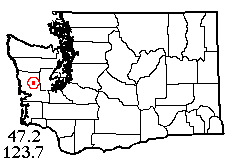
20 VI 2026: With Laurel still gone, Kathy and I recruited Carter Kitterman for his second spider trip. Our goal was an area in the Cascades south of Randle. For our first site, we parked at the edge of a mixed forest on the north rim of the Cispus River's not-so-deep gorge. Adjacent was a double clearcut with 16-year-old Douglas-firs in the shade on one side of the road (Carter beat their foliage) and 6-year-old trees in the sun (which I beat) on the other side. Again this situation gave us a high yield, 19 species, with 10 on Carter's side and 13 on mine. Kathy added 5 more by sweeping roadside grass with daisies. I sifted 2 more from maple litter, Carter found another 2 in a pile of dead wood and got a Neriene litigiosa from its dome web. Douglas-fir cones added nothing, but among the 8 species on roadside ferns was one more addition: site total, 30 species.
We spent the rest of the day at the Woods Creek nature trail, two loops of nearly level walking (1.4, 1.8 or 2.5 miles depending on what source you believe) through mixed forest, the edges of large meadows, and an old growth stand. The meadows seemed very enticing, so we forged on toward that part of the trail first. I had a map (found online) that showed the trail crossing meadows; false! It just skirts the edges. But they are beautiful (see album). Alas, we couldn't penetrate the first because the grass at the trail edge was interspersed with head-high nettles! And the last was too wet. But we got a few good spiders at the edge, then sped onward to the old growth, where we got a few dead-wood spiders (Kathy got the best one, a Zelotes). At this point Kathy and Carter disappeared from my ken. I could hear their voices and thought they must be ahead of me, so I tried to catch up. While I was ahead they decided to backtrack! We each passed the loop junction at different times and didn't actually meet again until back at the car. Audubon has made this Stop 42 on their "Great Washington State Birding Trail" but we didn't notice unusual numbers of birds.
After all that hiking, most of the species we got from the Woods Creek Loop were at the trailhead. I added one from litter and 4 by sifting moss Kathy brought me. She got one from conifers, a nice Platycryptus in the picnic shelter, and a mature Pardosa wolf spider ground-active. Carter swept a small grassy clearing for 5 species including an adult male Misumenops (Mecaphesa) sierrensis, first adult from western Washington! With 44 species from this gridspace, we deserved our burgers and shakes at the Huff 'n' Puff.
 |
9 VII 2026: Kathy, Jerry and I decided on a near-coastal site to escape moderate summer heat farther inland. I had a plan for a site on the upper Wishkah River (upstream of where we'd been before) where there was plenty of accessible Green Diamond land and an accessible pond. Having arrived, I couldn't get the new GPS to do anything simple like display our coordinates, so I hiked to the pond to confirm it was there. It was! I started by sifting riparian maple litter; wrong time of year, I guess, since I got no keeper spiders. Jerry decided this was his day to go hog-wild sifting moss, and did considerably better, with 10 species (not including the genus Callobius, of which he got 46 juveniles but not one adult). Kathy swept roadside grass from our parking spot to a bridge over an unnamed tributary, for 6 species. I and Jerry got 18 species from understory ferns, the day's best habitat.
Farther up the road (near the bridge), Kathy found one belated spring wolf spider "on the hoof" and a Cybaeus guarding her eggs under a stream cobble; also a Salticus on the bridge guardrail. I was hoping to find conifer foliage habitat, and there seemed to be a clearcut a little way beyond the bridge. But Kathy, who'd already checked it out, reported the trees were blocked by an impenetrable barrier of blackberry-laced brush (see album). She was right as far as the lower tier went, but when I followed the clearcut road beyond a tank trap that had stopped her, I soon got into a better section with 9- or 10-year-old Douglas-firs easy to reach. They yielded 13 species. Finally, the three of us assembled near the pond. My hope of getting wetland spiders was frustrated by deep mud; but some more moss sifting (Jerry), sweeping herbs in the overgrown road (Kathy) and beating Scots broom (me) added 4 more species in all. Our day's total was 39-40.
Welcome, fans, to another productive field year!
This page last updated 29 August, 2026